Industrial mixers
Jacketed reactor with agitator
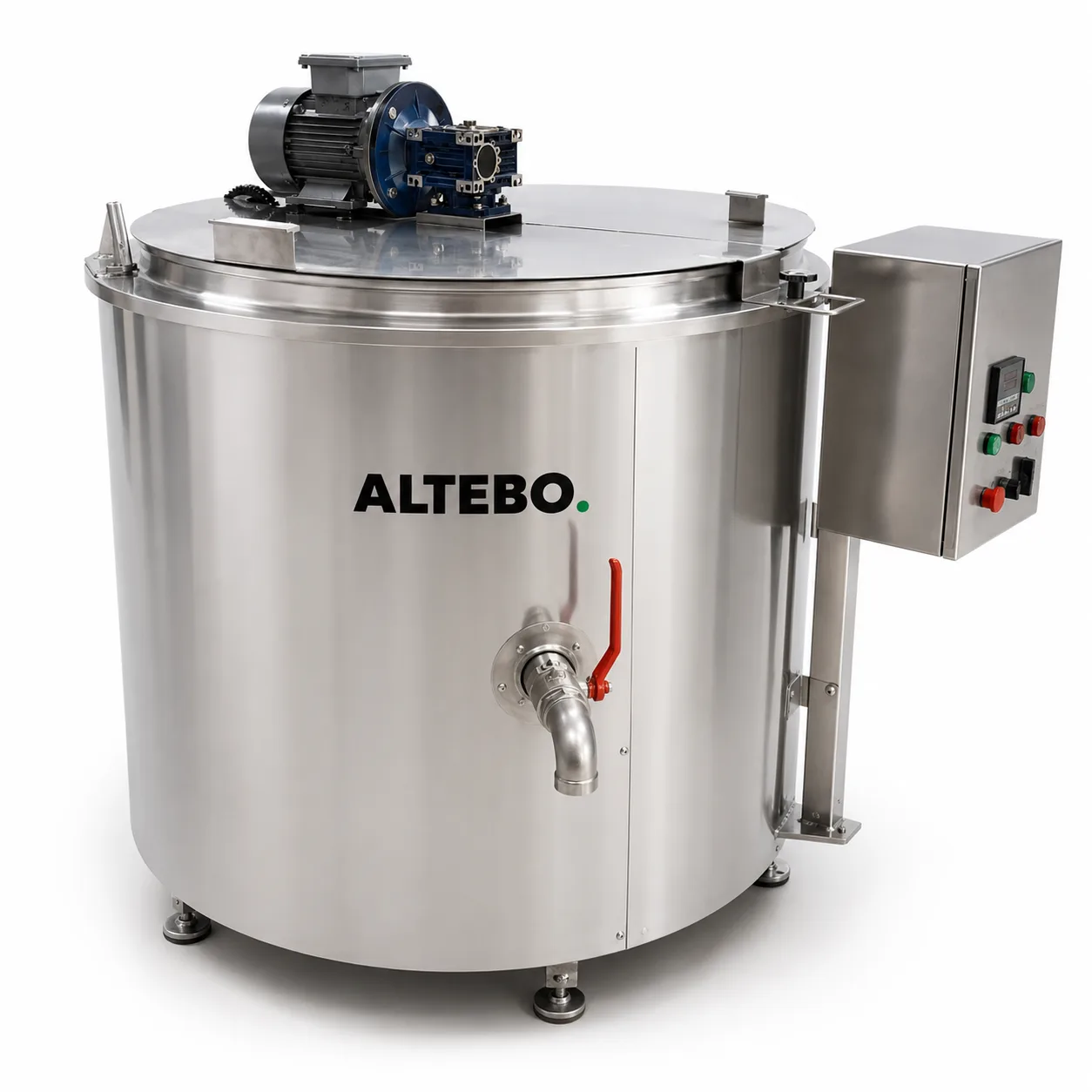
Vertical process vessel with an agitator and a thermal jacket, for chemical reactions, dissolving, dispersion and fermentation. AISI 316L stainless on the product side, built routinely from 100 to 10,000 L.
Also known as: process vessel with agitator · jacketed reactor · stirred tank reactor
Specifications
| Capacity | 100 – 10,000 L |
|---|---|
| Product contact material | AISI 316L stainless |
| Working temperature | Up to 250 °C (thermal jacket) |
| Agitator type | Propeller · turbine · anchor with scrapers — chosen on viscosity |
| Drive | Vertical gearmotor, variable speed |
| Options | CIP cleaning · vapour condenser · insulation · pipework |
The figures above are the ranges we build routinely, not construction limits. We design and manufacture any capacity, power rating and envelope to order — including below or above the ranges in the table.
Industrii
- Chemicals
- Pharma
- Food
- Individually sized — on your material, throughput and space
- Technical proposal and price, normally within 48 hours
- Installation, commissioning and service from our own plants
When to choose it
The concrete situations where this machine is the right answer — and the one where we recommend something else from our range.
The process involves a chemical reaction or a transformation that depends on temperature — the thermal jacket is the difference from an ordinary mixer.
You dissolve solids in a liquid or disperse one phase in another and need adjustable speed across the stages of the recipe.
The product sticks to the vessel wall: an anchor agitator with scrapers keeps the heat transfer surface continuously clean.
You work in pharma or food and need cleaning without dismantling — the vessel is supplied with a CIP system.
When this is NOT the right machine
If you mix dry powders with no heat input and no liquid phase, a vertical jacketed vessel costs far more than the process requires.
Vezi Ribbon blenderHow it works
The jacketed reactor is a vertical process vessel with an agitator, intended for operations where mixing has to be coupled with controlled process parameters: chemical synthesis and neutralisation, dissolving, dispersion, fermentation, pasteurisation, and hot food or cosmetic preparations.
The agitator is selected for the viscosity and behaviour of the product — propeller or turbine for fluid media, anchor with scrapers for products that stick to the wall — and the speed is set from a frequency inverter. Temperature, pressure and process time are monitored through the vessel instrumentation and controlled automatically, for repeatable reaction conditions batch after batch.
The vessel is built in AISI 316L stainless on the product side, with a thermal jacket for heating or cooling, insulation and a cover carrying inspection ports, connections and probes. On request the reactor is supplied with a CIP cleaning system, a vapour condenser and complete pipework, ready for integration into the existing plant.
Agitator matched to the product
Propeller, turbine or anchor with scrapers — chosen on viscosity.
Controlled process parameters
Temperature, pressure and speed monitored automatically.
Heating / cooling jacket
Thermal medium in the jacket, for processes at controlled temperature.
Ready for integration
Connections, instrumentation and CIP on request — connects straight into the plant.
Variante constructive
What actually differs between them — not just what they are called.
Propeller or turbine agitator
For fluid, low-viscosity media. A turbine generates higher shear — specify it when one phase has to be dispersed in another.
Anchor agitator with scrapers
For viscous, sticky products. The scrapers keep the wall clean, so heat transfer through the jacket stays constant throughout the cycle.
With a heating / cooling jacket
Thermal medium in the jacket — steam, hot water or refrigerant, depending on the process.
With a CIP cleaning system
Spray balls fitted in the cover; the vessel is cleaned without dismantling and without anyone entering it.
Frequently asked questions
Question not answered here? Write to us — an engineer replies, nu un robot.
What pressure will the vessel take?
The design pressure is established on the process and recorded in the vessel documentation.
Does the vessel come certified as pressure equipment?
State in your enquiry whether your process requires certification — it affects both the build and the documentation.
How do I choose between propeller, turbine and anchor?
By the viscosity of the product. Propellers and turbines work in fluid media and create flow through the whole mass; the anchor with scrapers is used for viscous, sticky products, where the others would simply spin a cavity in the middle. Give us the viscosity and density and we will recommend the type.
What thermal medium does the jacket use?
Steam, hot water or refrigerant, depending on the temperature the process requires — up to 250 °C. We build the jacket connections to match the utilities you already have in the plant.
Can it be connected to our existing plant without changing pipe runs?
Yes — we supply the reactor with the connections, the instrumentation and, on request, the pipework built to your plant layout. Send us the flow diagram and the positions of the existing connections.