Industrial mixers
Z-blade mixer
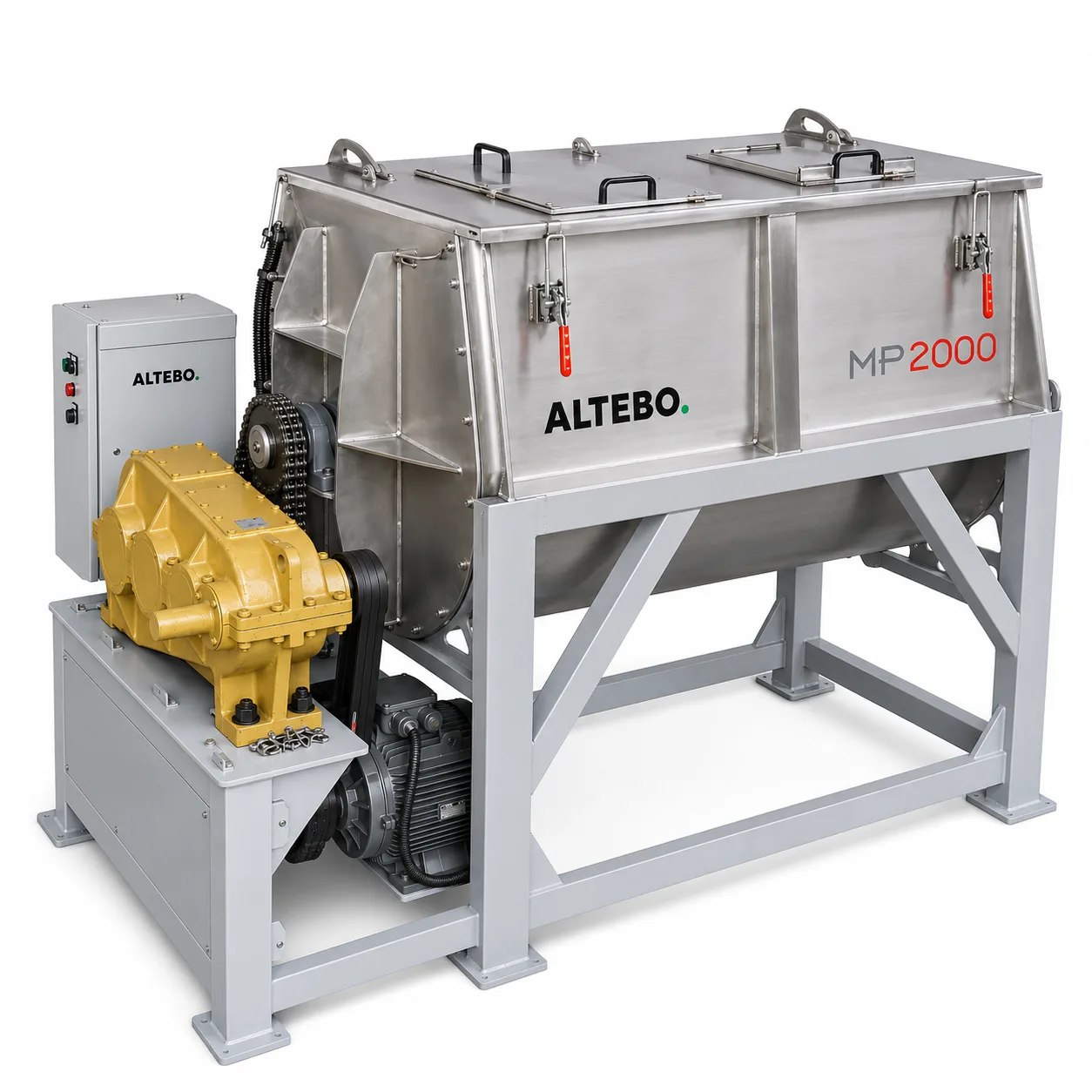
Kneader with two counter-rotating Z-blades for viscous masses — dense doughs, fillers, adhesives, gum base, technical pastes. Built routinely from 50 to 3,000 L per batch.
Also known as: sigma mixer · kneader · double-arm kneading mixer
Specifications
| Capacity | 50 – 3,000 L / batch |
|---|---|
| Product contact material | AISI 304 / 316L stainless or treated steel |
| Motor power | 4 – 90 kW |
| Drive | Twin synchronised gearmotors, at different speeds |
| Discharge | Hydraulic trough tilting or extraction screw |
| Options | Heating / cooling jacket · hydraulic tilting · vacuum operation |
The figures above are the ranges we build routinely, not construction limits. We design and manufacture any capacity, power rating and envelope to order — including below or above the ranges in the table.
Industrii
- Food
- Chemicals
- Pharma
- Individually sized — on your material, throughput and space
- Technical proposal and price, normally within 48 hours
- Installation, commissioning and service from our own plants
When to choose it
The concrete situations where this machine is the right answer — and the one where we recommend something else from our range.
The material is so viscous that a ribbon or paddle mixer turns inside it without working it — Z-blades stretch, cut and fold it.
You produce dense doughs, fillers, adhesives or plasticised masses, where mixing is really mechanical kneading.
The mass heats up from its own friction and has to be cooled, or conversely has to be heated to become workable — the trough is built with a jacket.
The product is too stiff to flow through a valve: the trough tilts hydraulically or is emptied by an extraction screw in its base.
When this is NOT the right machine
For dry, free-flowing powders a kneader is a heavily oversized construction — it draws far more power than the process requires.
Vezi Ribbon blenderHow it works
The Z-blade mixer, or kneader, is intended for high-viscosity materials, where mixing means kneading: dense doughs and fillings, gum base, fillers, adhesives, technical pastes and plasticised masses. Where a ribbon or paddle mixer slips over the surface of the product, Z-blades penetrate it and work it through.
The two Z-shaped blades rotate in opposite directions at different speeds, in a trough with a double half-cylinder bottom: the material is stretched, cut and folded continuously between the blades and the trough walls — the classic kneading mechanism, which disperses the components evenly through the viscous mass.
The trough and blades are built in AISI 304/316L stainless or treated steel, with a heating or cooling jacket on request for controlling the temperature of the kneaded mass. Discharge is by hydraulic tilting of the trough or through an extraction screw mounted in its base, and the oversized drive sustains the kneading load in continuous operation.
Counter-rotating Z-blades
Different speeds on the two blades — continuous stretching, cutting and folding.
For high viscosity
Doughs, fillers, adhesives, plasticised masses — worked through in depth.
Controlled temperature
Heating / cooling jacket on the trough, on request.
Tilting or screw discharge
Complete emptying, chosen for the consistency of the product.
Variante constructive
What actually differs between them — not just what they are called.
Discharge by hydraulic tilting
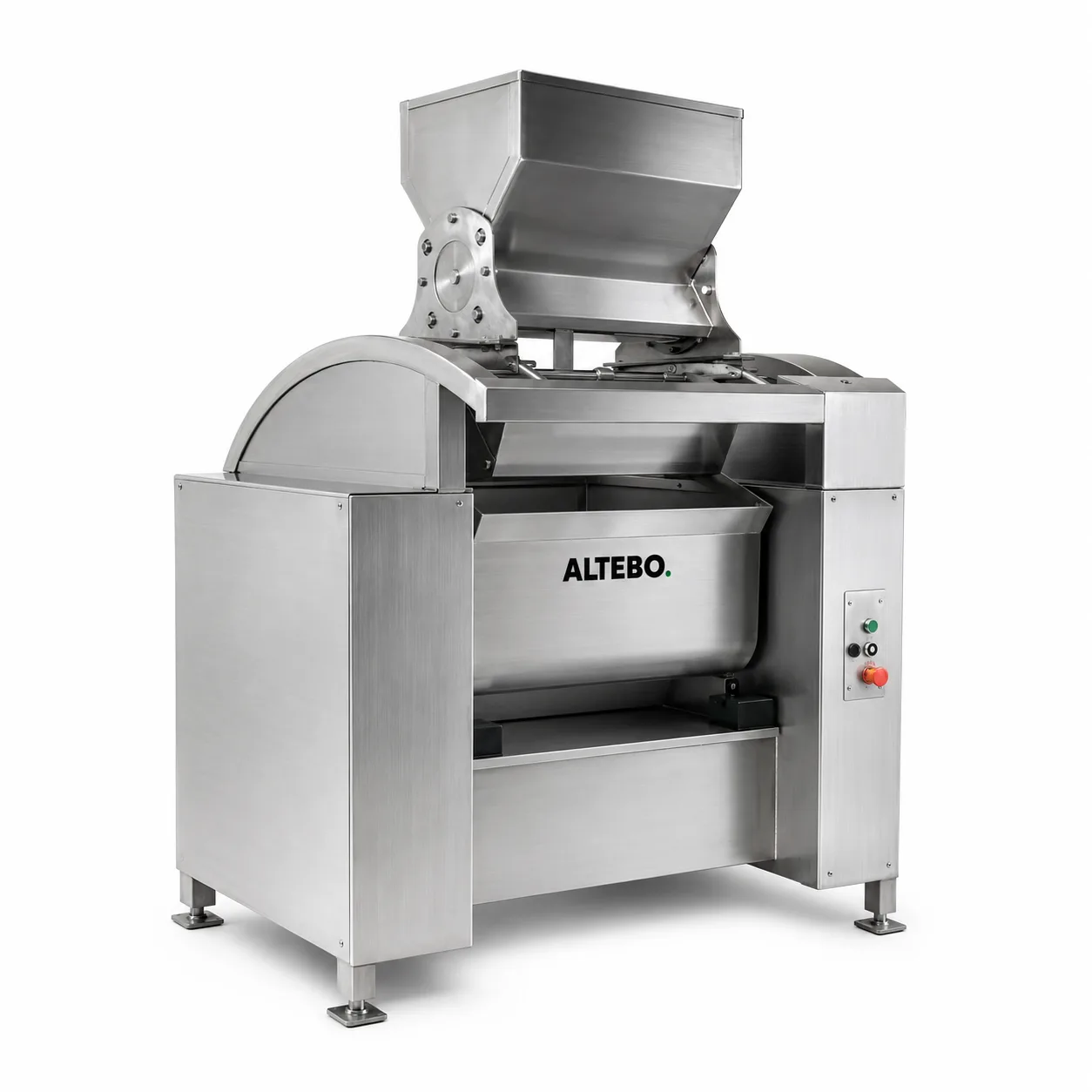
The trough tips over completely. Suitable for very stiff masses that will not flow on their own, and for small and medium capacities.
Discharge by extraction screw
A screw in the base of the trough pushes the mass out. Chosen at large capacities, where tilting would require a disproportionate structure and hydraulic unit.
With a heating / cooling jacket
For products that must be held within a temperature range during kneading — the mass heats itself through friction, so the jacket is often used for cooling.
With vacuum operation
A sealed trough, for de-aerating the mass during kneading — used for pastes where air bubbles are a product defect.
Frequently asked questions
Question not answered here? Write to us — an engineer replies, nu un robot.
What maximum viscosity can it handle?
See the “Maximum viscosity” row in the specification table. Send us a description of the product — consistency, behaviour with temperature, density — and we will size the drive for the real kneading load.
Why do the two blades rotate at different speeds?
The speed difference is what produces the kneading: material is picked up by the fast blade and handed to the slow one, being stretched and folded between them. If they ran at the same speed, the mass would simply rotate as a block without being worked.
How is it emptied if the product does not flow?
In two ways, depending on capacity: by hydraulic tilting of the trough (at small and medium volumes) or with an extraction screw mounted in the base (at large volumes, where tilting would need a disproportionate structure).
Does the product heat up during kneading?
Yes — internal friction in a viscous mass generates heat, sometimes enough to change the consistency of the product. That is why the jacket is frequently specified for cooling, not only for heating.
How difficult is it to clean?
Harder than a powder mixer — a viscous mass adheres to the blades and the walls.
Can it be used in the food industry?
Yes, built in AISI 304/316L stainless with continuous ground welds — it is the usual machine for dense doughs and fillings. State in your enquiry whether you need a sanitary finish and material certificates.