Industrial mixers
Paddle mixer
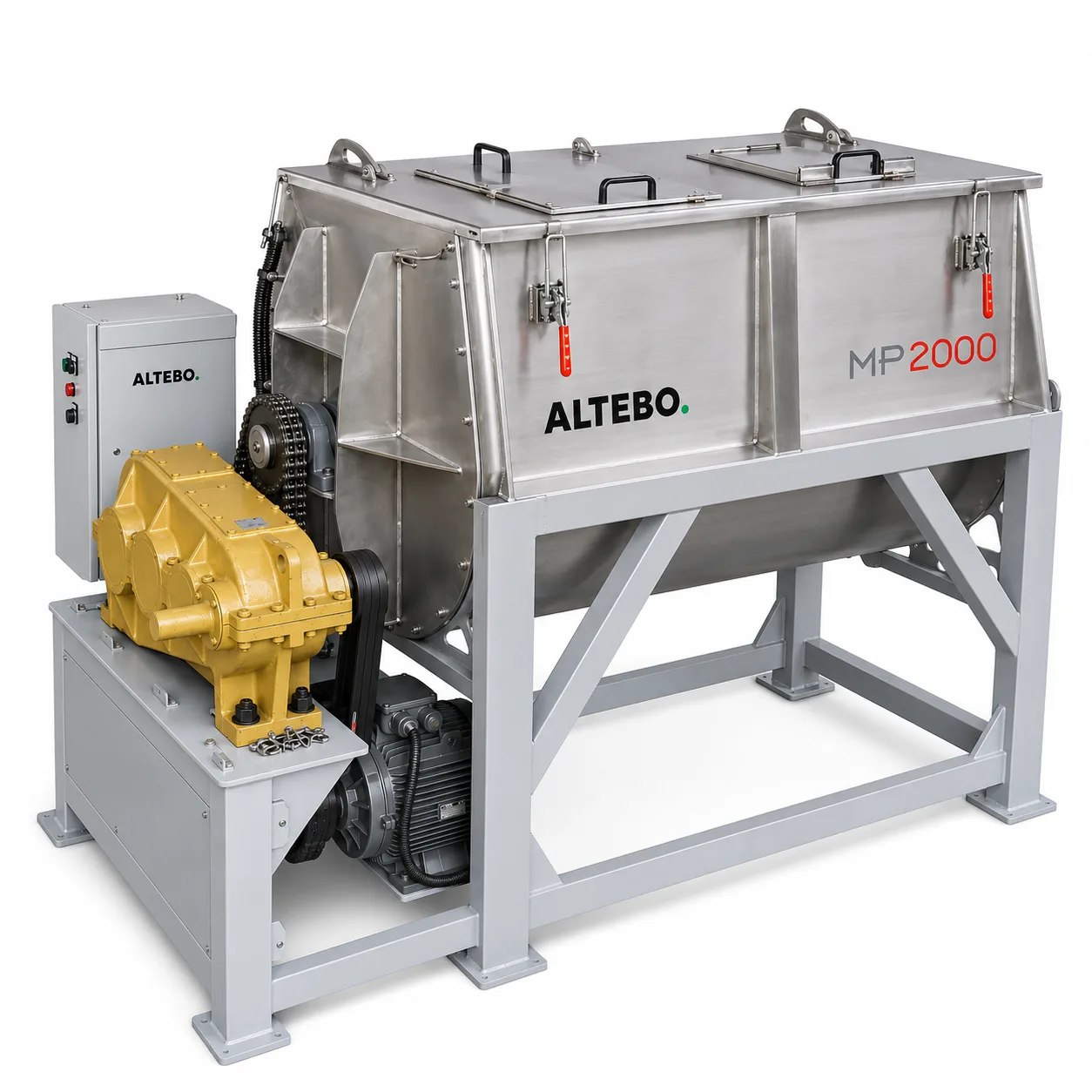
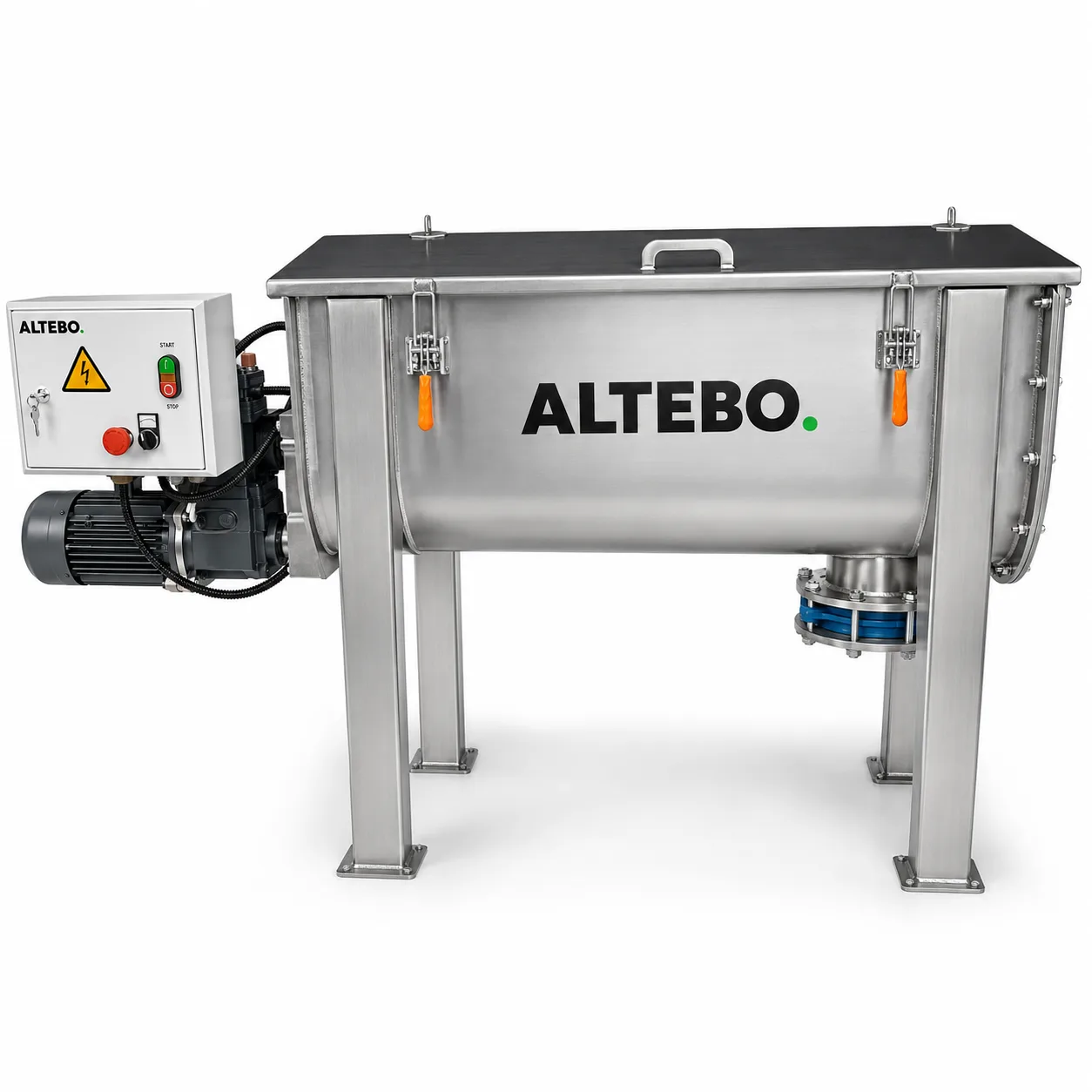
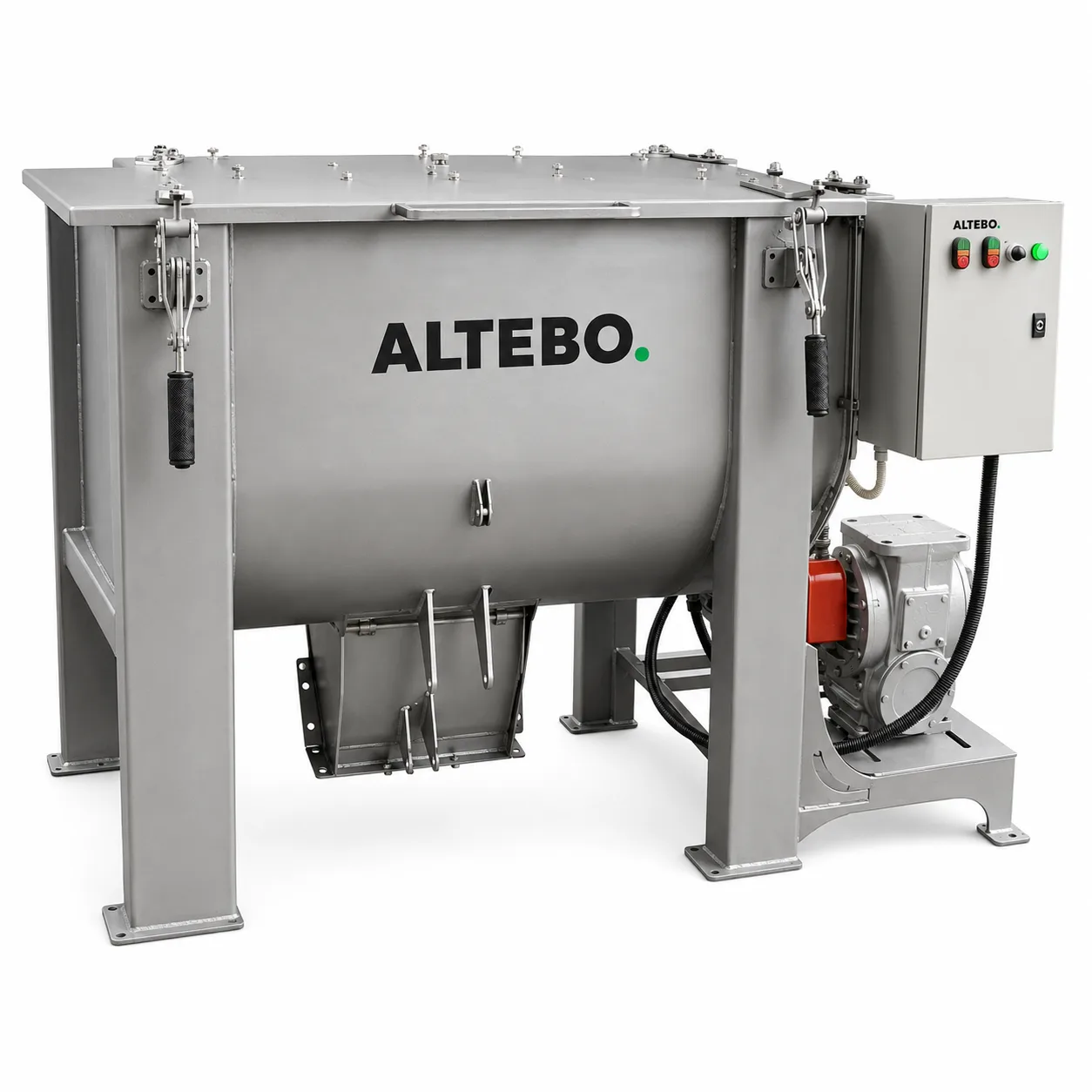
Horizontal paddle mixer for powders, granulates and recipes with liquid addition — flavours, oils, binders, colourants sprayed over the dry phase. Built routinely from 100 to 5,000 L per batch.
Also known as: horizontal paddle mixer · single-shaft paddle mixer
Specifications
| Capacity | 100 – 5,000 L / batch |
|---|---|
| Product contact material | AISI 304 / 316L stainless |
| Motor power | 1.5 – 45 kW |
| Drive | Gearmotor with adjustable speed |
| Liquid addition | Spray nozzles in the cover (optional) |
| Options | Spray nozzles · load cells · multiple discharge valves |
The figures above are the ranges we build routinely, not construction limits. We design and manufacture any capacity, power rating and envelope to order — including below or above the ranges in the table.
Industrii
- Food
- Chemicals
- Pharma
- Individually sized — on your material, throughput and space
- Technical proposal and price, normally within 48 hours
- Installation, commissioning and service from our own plants
When to choose it
The concrete situations where this machine is the right answer — and the one where we recommend something else from our range.
The recipe has a dry phase over which a liquid is sprayed — oil, flavour, binder, colourant. The paddles keep the product moving while the nozzles spray, so the liquid does not form lumps.
You mix fragile granulates that must not be broken up: the paddle angle and speed are chosen for gentle action.
You have components of very different densities — the staggered paddles lift and tumble material across the whole cross-section, not just at the surface.
You change recipes frequently: full-length covers allow cleaning without removing the shaft.
When this is NOT the right machine
If you have to distribute an additive at a very low concentration — under 1 % of the batch — mechanical fluidisation gives a more reliable distribution than paddles.
Vezi Ploughshare mixerHow it works
The paddle mixer covers the widest range of applications among horizontal mixers: powders and granulates of differing densities, fragile products that will not take high shear, and recipes in which liquids — flavours, oils, binders or colourants — are sprayed over the dry phase.
Profiled paddles, staggered along the shaft, lift and tumble the material across the whole cross-section of the trough, generating a three-dimensional mixing motion. The paddle angle and the shaft speed are chosen at design stage, so that the same construction can work gently with fragile granulates or intensively with agglomerating powders.
The U-shaped trough is built in AISI 304/316L stainless, with inspection covers along its full length, product-specific shaft seals and, on request, spray nozzles for the liquid phase. The control sets the speed and the mixing time per recipe, with discharge through one or more pneumatic valves.
Three-dimensional motion
Staggered paddles that lift and tumble the product through the whole trough.
Adjustable intensity
Paddle angle and speed chosen for the sensitivity of the product.
Liquid additions
Spray nozzles for flavours, oils and binders, on request.
Full access
Inspection covers along the whole trough, quick cleaning.
Variante constructive
What actually differs between them — not just what they are called.
Standard paddles, single shaft
The usual version, for batch mixing of powders and granulates.
With spray nozzles
A nozzle manifold in the cover, for introducing the liquid phase during mixing. The number and position of nozzles are chosen from the proportion of liquid in the recipe.
With chopper blades
Independently driven choppers, side-mounted, which break up the agglomerates that form where powder meets liquid.
With a thermal jacket
For recipes where the product has to be heated or cooled during mixing.
Frequently asked questions
Question not answered here? Write to us — an engineer replies, nu un robot.
What proportion of liquid can I add over the dry phase?
Above a certain proportion the mix goes from wetted powder to paste, and the right machine becomes the Z-blade mixer. Tell us the recipe and we will tell you which zone you are in.
How does it differ from a ribbon blender?
The ribbon creates a constant axial circulation and is the most predictable choice for dry, free-flowing powders. Paddles lift and tumble the material, so they work better with very different densities, with fragile granulates and with liquid addition. If the recipe is strictly dry and uniform in particle size, the ribbon is the more economical choice.
Does it break up granulates?
Not if the paddle angle and the speed are chosen for that — which is why we set them at design stage rather than taking them from a standard model. Tell us what you are mixing and how fragile it is.
Can the recipe be weighed directly in the mixer?
Yes, mounted on load cells. That removes the need for a separate weighing hopper upstream.
How quickly can it be cleaned between recipes?
The inspection covers open along the whole trough and give access to the shaft and the paddles without dismantling, which is the difference from a construction with a small hatch.
What if we change the product in a year — will it still be usable?
The paddle angle is adjustable and the speed changes from the inverter, so the machine covers a wide range of recipes without mechanical modification. If the new product falls outside the range it was sized for, the paddles can be replaced.