Industrial mixers
Pug mill mixer
Continuous twin-shaft mixer for clay, ceramic bodies, cement-based mixes and sludge — mixes and conveys at the same time, at a constant rate between 1 and 30 m³/h.
Also known as: continuous twin-shaft mixer · continuous clay mixer · pugmill
Specifications
| Throughput | 1 – 30 m³/h (continuous) |
|---|---|
| Material | Wear-resistant steel; stainless on request |
| Motor power | 5.5 – 75 kW |
| Drive | Gearmotors on two shafts |
| Paddles | Individually replaceable, helically arranged |
| Options | Stainless build · hinged covers · metered water feed |
The figures above are the ranges we build routinely, not construction limits. We design and manufacture any capacity, power rating and envelope to order — including below or above the ranges in the table.
Industrii
- Construction
- Chemicals
- Individually sized — on your material, throughput and space
- Technical proposal and price, normally within 48 hours
- Installation, commissioning and service from our own plants
When to choose it
The concrete situations where this machine is the right answer — and the one where we recommend something else from our range.
The line runs continuously rather than in batches: the downstream machine has to be fed constantly with homogeneous material at a steady rate.
You process clay or ceramic bodies that have to be plasticised — the continuous shear between paddles and walls is the plasticising process itself.
The material has uneven moisture at the inlet and it has to be equalised before the next machine.
The composition is abrasive and you want cheap maintenance: paddles are replaced individually, without changing the mixing chamber.
When this is NOT the right machine
If you produce on frequently changing recipes and need traceability for every batch, a continuous machine does not give you lot separation.
Vezi Twin-shaft mixerHow it works
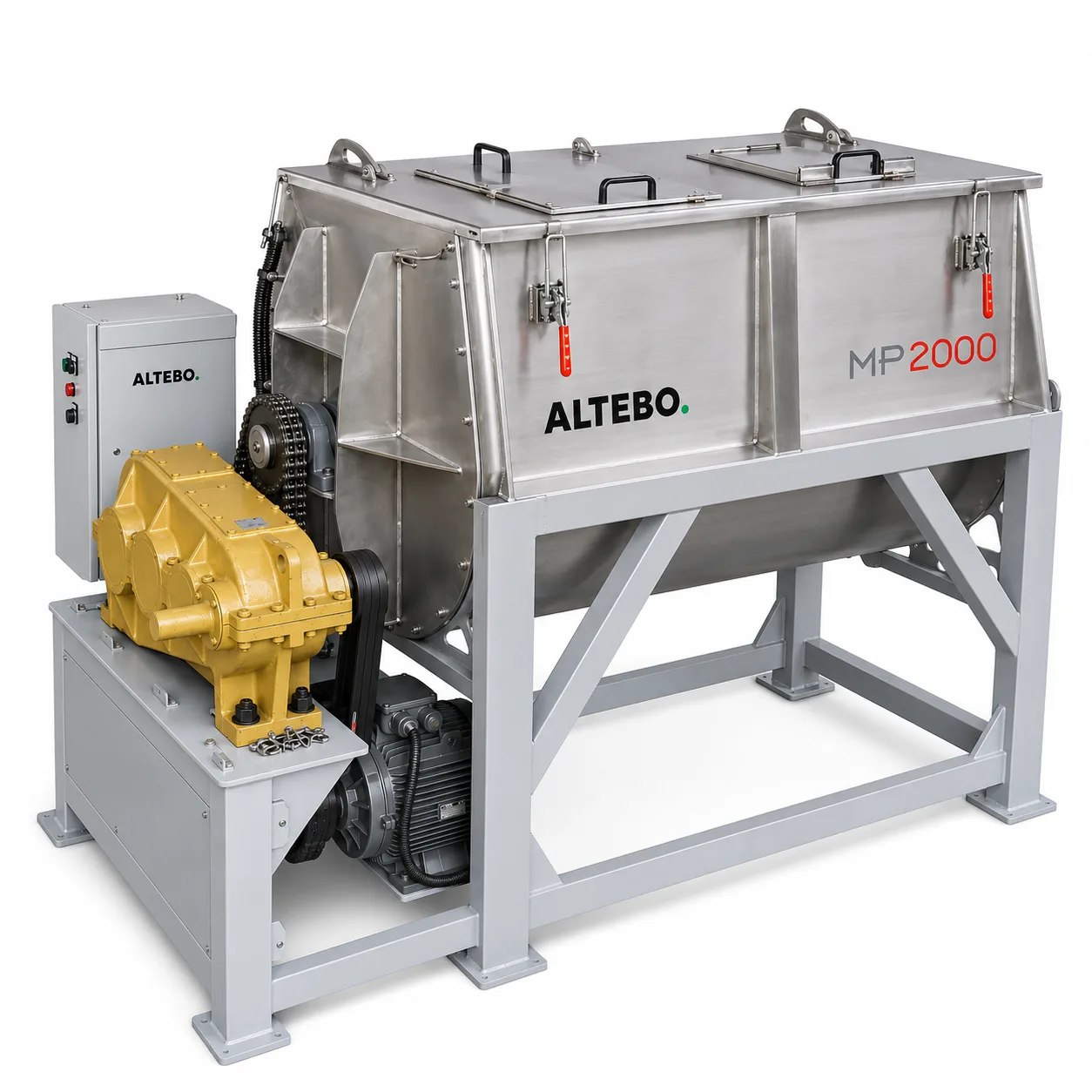
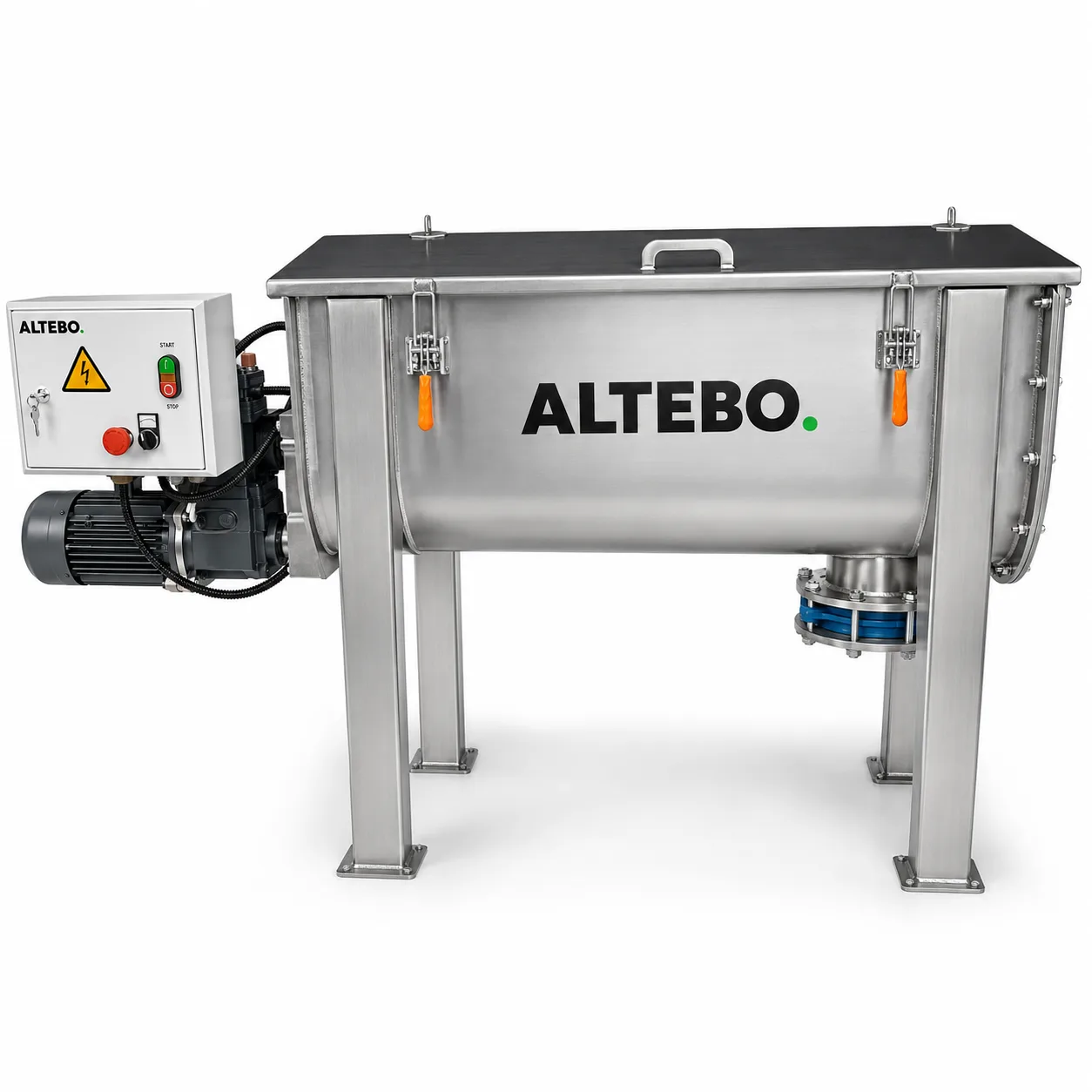
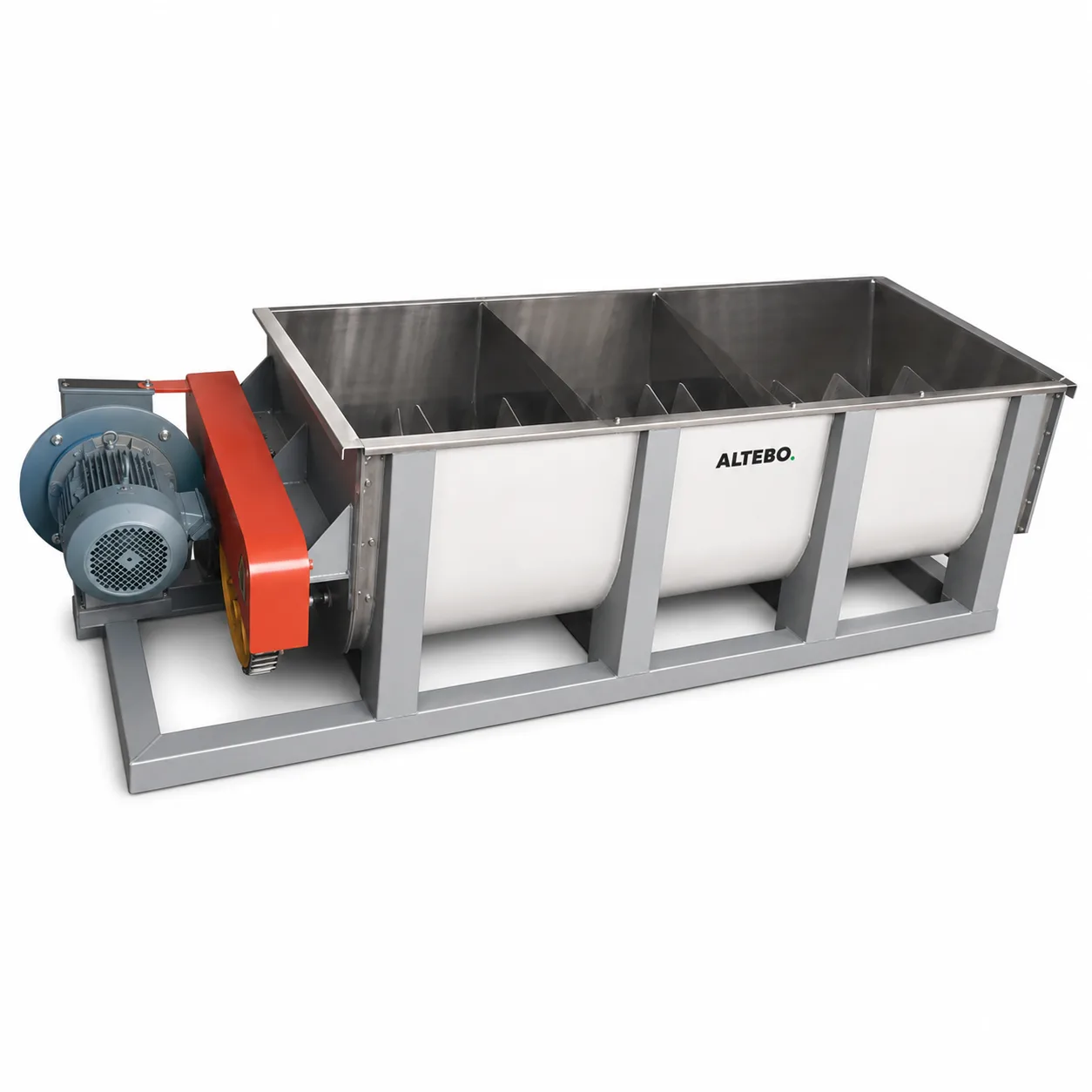
The pug mill is a continuously operating mixer, intended for viscous and plastic materials: clay and ceramic bodies, cement-based mixes, sludge and similar compositions. It is installed in the line, between the feed and the downstream machine, which it supplies with homogeneous material at a constant rate.
The two parallel shafts, fitted with helically arranged paddles, mix the material and convey it simultaneously from the feed opening to the discharge. Along the way, the composition is continuously sheared and kneaded between the paddles and the mixing chamber walls — the plasticising process characteristic of clay working — and what leaves the discharge is a uniform mass with evenly distributed moisture.
The mixing chamber and paddles are built in treated wear-resistant steel, with individually replaceable paddles and, on request, in stainless for corrosive media. The throughput is matched to the line by adjusting the speed from a frequency inverter, and hinged covers give quick access for cleaning and paddle changes.
Continuous operation
Mixes and conveys at once — constant rate to the downstream machine.
Plasticising by shear
Continuous kneading between the paddles and the mixing chamber.
Replaceable wear-resistant paddles
Treated steel, changed individually — low maintenance cost.
Adjustable throughput
Speed from a frequency inverter, matched to the pace of the line.
Variante constructive
What actually differs between them — not just what they are called.
Wear-resistant steel
The standard version, for clay, cement and ceramic bodies.
Stainless build
For corrosive media and for chemically aggressive sludge.
With metered water feed
A water manifold on the mixing chamber, for correcting moisture directly in the process.
Frequently asked questions
Question not answered here? Write to us — an engineer replies, nu un robot.
How does it differ from a batch mixer?
In that feeding and discharge are simultaneous: material enters at one end and leaves homogeneous at the other, without stopping. You gain a constant rate to the downstream machine, but you lose lot separation — you cannot say that a given quantity was mixed separately.
What throughput can it sustain?
We build routinely between 1 and 30 m³/h, and the rate is adjusted from a frequency inverter to match the pace of the line. This is not a construction limit — we size to order above it as well.
How often are the paddles changed?
Paddles are changed individually, without dismantling the mixing chamber — which is why it is routine maintenance rather than a repair.
Can it correct the moisture of the material?
Yes, with a water manifold fitted on the mixing chamber — see the “With metered water feed” version.
Does it clog with sticky material?
Hinged covers give quick access along the whole chamber for cleaning.
Can it be installed in an existing line?
Yes — the position of the feed and discharge openings is set on the route in your plant. Send us the line layout and the throughput required by the downstream machine.