Industrial mixers
Rotating drum mixer
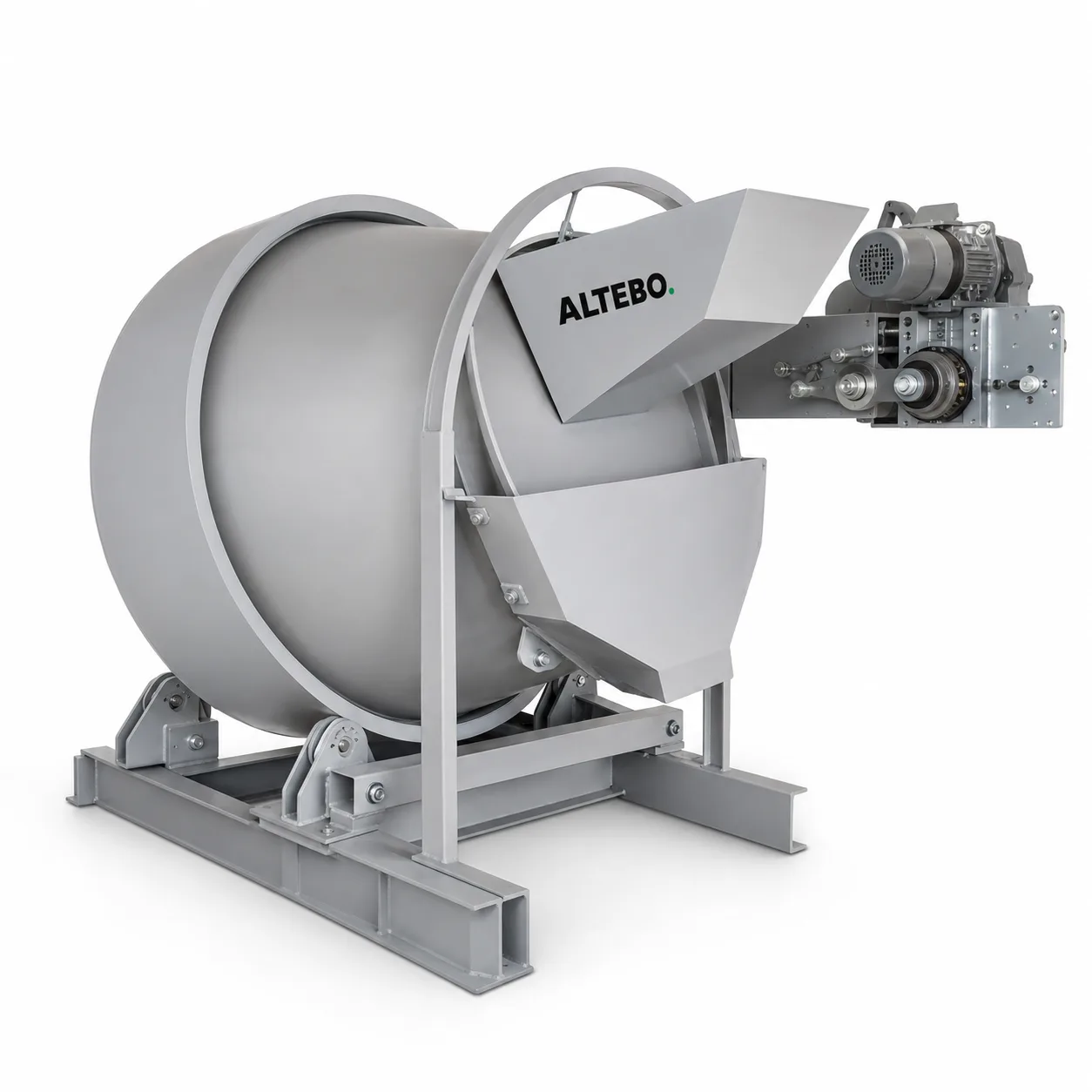
Rotating drum mixer in wear-resistant steel for concrete, mortar, screeds and raw ceramic bodies — production plants and precast workshops. Built routinely from 250 to 3,000 L per batch.
Also known as: drum mixer · industrial concrete mixer · tumbling drum mixer
Specifications
| Capacity | 250 – 3,000 L / batch |
|---|---|
| Material | Treated wear-resistant steel |
| Motor power | 3 – 37 kW |
| Drive | Ring gear and pinion |
| Discharge | Drum tilting or reversal of rotation |
| Options | Adjustable mixing time · mechanical guards · emergency stop |
The figures above are the ranges we build routinely, not construction limits. We design and manufacture any capacity, power rating and envelope to order — including below or above the ranges in the table.
Industrii
- Construction
- Individually sized — on your material, throughput and space
- Technical proposal and price, normally within 48 hours
- Installation, commissioning and service from our own plants
When to choose it
The concrete situations where this machine is the right answer — and the one where we recommend something else from our range.
You mix compositions with abrasive aggregates — concrete, mortar, screeds — which would rapidly wear out a stainless ribbon or paddle mixer.
You need a machine with minimal maintenance, working intensively in a production plant or a precast workshop.
Batches follow one another quickly and the machine restarts frequently under load — the ring gear and pinion drive is sized for that.
You produce precast elements and need a homogeneous mix, with no hygiene or sanitary finish requirements.
When this is NOT the right machine
If the line requires simultaneous feeding and discharge at a constant rate, a batch machine limits your capacity.
Vezi Pug mill mixerHow it works
The rotating drum mixer is intended for the heavy, abrasive compositions of the construction industry: concrete, mortar, screeds, mixes for precast elements and raw ceramic bodies. Its simple, robust construction makes it suitable for intensive duty in production plants and precast workshops.
Mixing is achieved by continuous rotation of the drum, fitted internally with helical paddles: the material is lifted by the paddles and falls by gravity through the mass of the mix, a cycle repeated until homogeneity is reached. Discharge is by tilting the drum or by reversing the direction of rotation, depending on the version.
The drum and paddles are built in wear-resistant treated steel, and the ring-gear-and-pinion drive is sized for repeated starts under load. The control provides adjustable mixing time, and the mechanical guards and emergency stop cover the safety requirements for site work.
Drum with helical paddles
Lifting and gravity fall — homogenising of heavy compositions.
Wear-resistant steel
Resistant to abrasion from aggregates, cement and sand.
Ring gear and pinion drive
Sized for repeated starts with a full drum.
Simple operation
Adjustable mixing time, minimal maintenance, emergency stop.
Variante constructive
What actually differs between them — not just what they are called.
Discharge by tilting the drum
The drum tips for emptying. A simple construction, suitable at small and medium capacities.
Discharge by reversing rotation
The helical paddles push the material out when the drum turns the other way. The drum stays fixed, so the structure is simpler at large capacities.
With replaceable paddles
Paddles are changed individually, without replacing the drum — relevant with strongly abrasive compositions.
Frequently asked questions
Question not answered here? Write to us — an engineer replies, nu un robot.
How long do the drum and paddles last with abrasive compositions?
See the “Paddle service life” row in the specification table. We build the drum and paddles in treated wear-resistant steel, and on request the paddles can be replaced individually.
Which discharge version is better?
At small and medium capacities, tilting the drum is the simplest. At large capacities, reversing the rotation avoids a heavy and expensive tilting structure — the drum stays fixed and the helical paddles push the material out.
Can I mix ceramic bodies as well as concrete?
Yes — raw ceramic bodies are within the application range. If the body is plastic and has to be plasticised continuously, in flow, then the right machine is the pug mill.
What is the mixing time for a batch?
The time is set from the control and is established experimentally on the concrete or mortar recipe in use.
Can it be integrated into an existing concrete plant?
Yes — we size the charging and discharge openings to the existing machines. Send us the plant layout and the required throughput.