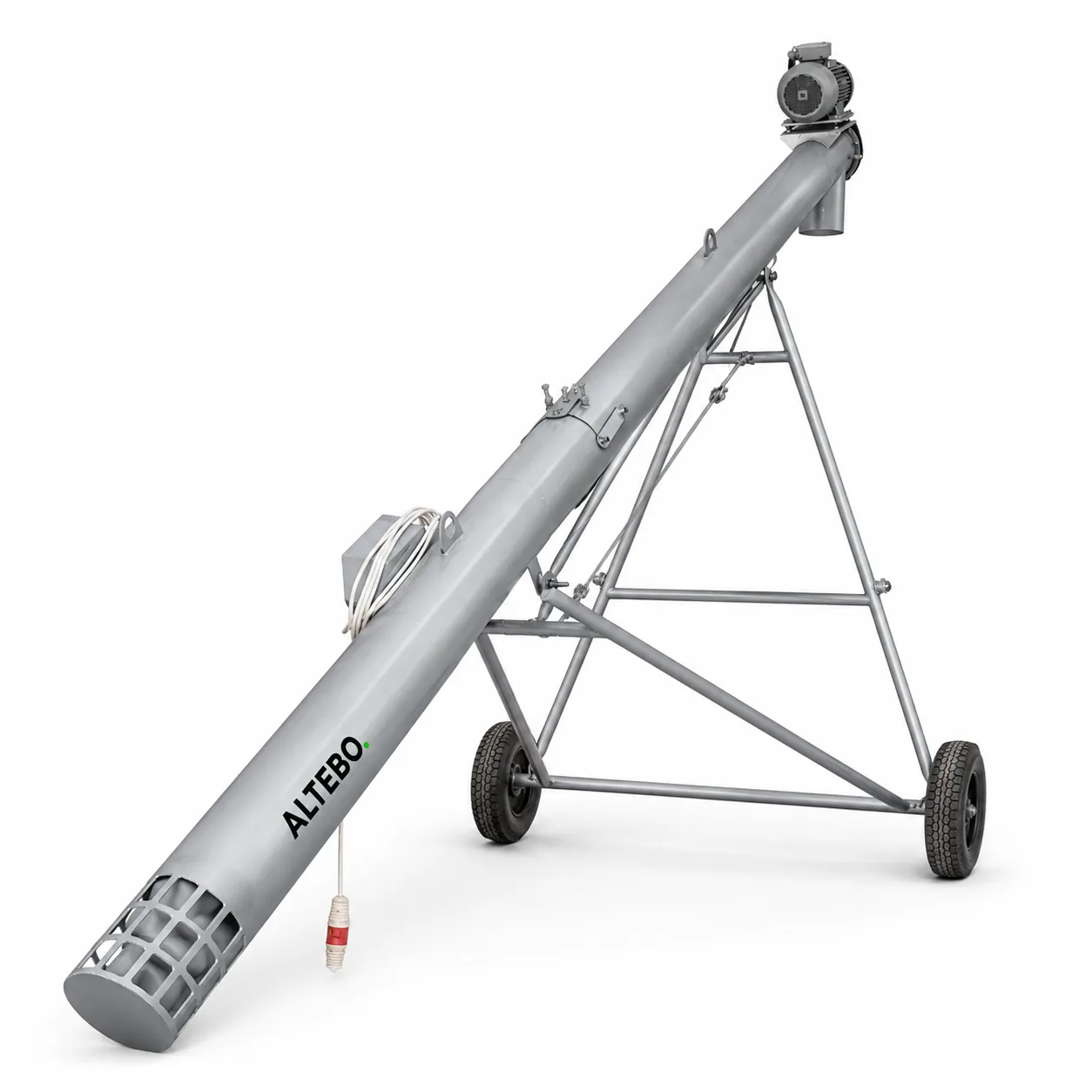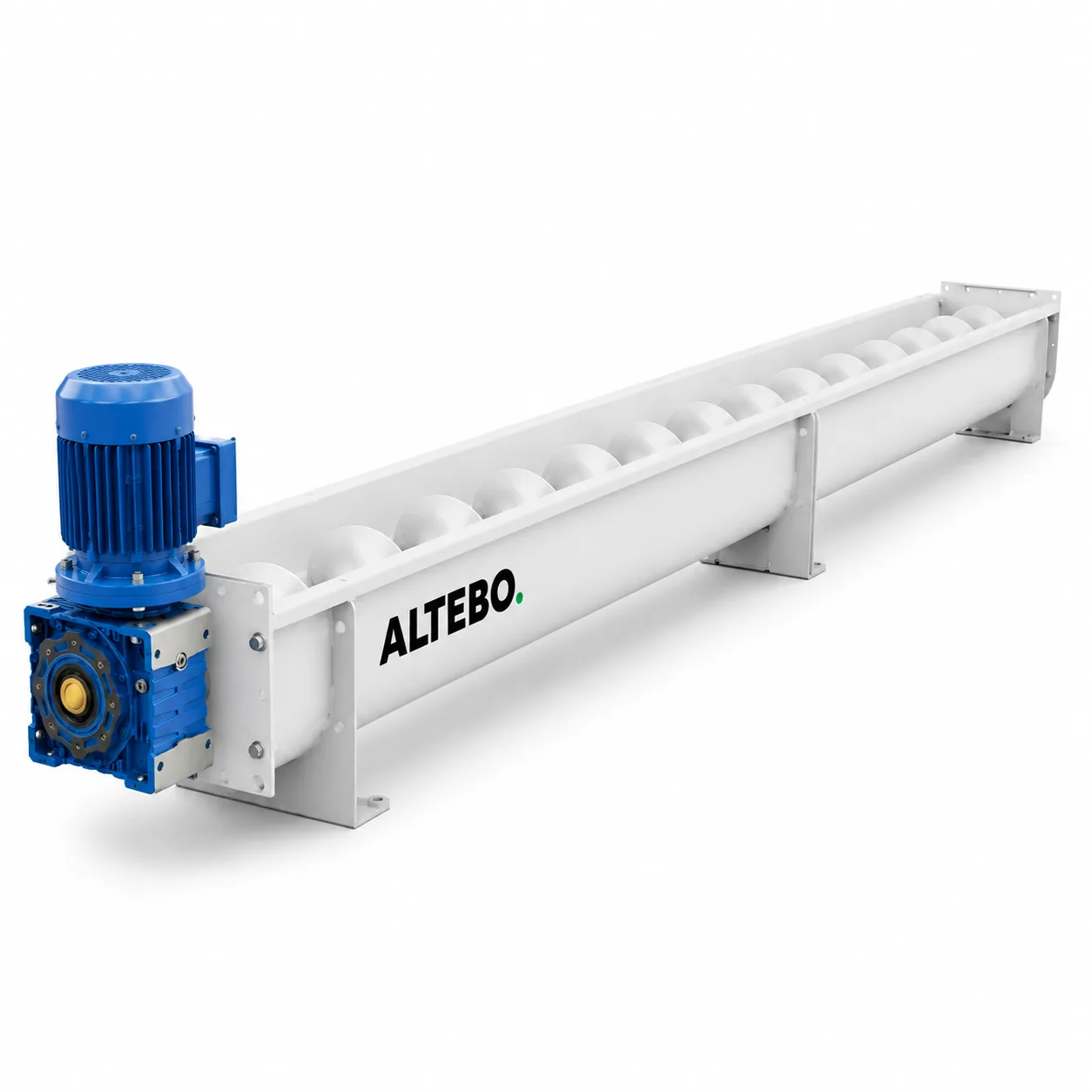
Screw conveyors
Screw conveyor / auger conveyor / spiral conveyor
Helical screw conveyor for bulk material, horizontal or inclined — flour, gypsum, cement, plastic granulate, meals, sludge. Three constructions: tubular, U-trough and shaftless. Built routinely at throughputs of 1 – 120 m³/h.
Also known as: screw conveyor · auger conveyor · spiral conveyor · tubular screw conveyor · shaftless screw conveyor · screw feeder
Specifications
| Throughput | 1 – 120 m³/h |
|---|---|
| Flight diameter | Up to Ø 1,200 mm |
| Length | To order, on the route in your plant |
| Material | AISI 304 / 316L stainless or protected carbon steel |
| Motor power | 0.75 – 22 kW |
| Maximum temperature | 180 °C |
| Drive | Directly coupled gearmotor |
| Versions | Tubular · U-trough · shaftless |
| Options | Removable covers · multiple openings · dust-tight build |
The figures above are the ranges we build routinely, not construction limits. We design and manufacture any capacity, power rating and envelope to order — including below or above the ranges in the table.
Industrii
- Chemicals
- Food
- Construction
- Agriculture
- Individually sized — on your material, throughput and space
- Technical proposal and price, normally within 48 hours
- Installation, commissioning and service from our own plants
When to choose it
The concrete situations where this machine is the right answer — and the one where we recommend something else from our range.
You move bulk material horizontally or on an incline, on a fixed route in the hall, and you want the dust kept out of the atmosphere — the screw is enclosed along its whole length.
You need the throughput to be constant and controllable, not just for the material to get from one point to another: diameter, pitch and speed determine the rate, so the screw can meter-feed the downstream machine.
The material is sticky, fibrous or contains foreign objects — sludge, screenings, waste — and a centre shaft would clog: the shaftless version is chosen.
The route has multiple feed or discharge openings, in positions dictated by the existing machines.
When this is NOT the right machine
If the material has to be lifted vertically to a significant height, an inclined screw loses a lot of throughput and needs a long run for little height gained.
Vezi Bucket elevatorHow it works
The screw conveyor — also called an auger or spiral conveyor — moves powdered and granular materials horizontally or on an incline: flour, gypsum, cement, technical dust, plastic granulate, meals, as well as sludge and screenings at treatment plants. Being an enclosed machine, it protects the material from contamination and the hall from dust emissions.
The helical flight pushes the material along the trough or tube. Throughput is determined by the diameter, pitch and speed of the flight — parameters set at design stage from the density and behaviour of the material — and stays constant and controllable, which also makes the screw suitable for metered feeding of downstream machines.
The choice between the three constructions follows from the material and the route: tubular for sealed runs and steep inclines, U-trough for full cleaning access, shaftless for sticky or fibrous material and material containing foreign objects — the case of treatment plant sludge, where a centre shaft would clog.
The build is AISI 304/316L stainless for food, pharmaceutical and chemical applications, or protected carbon steel for general industrial duty, with diameters built routinely up to 1,200 mm, lengths to order, and feed and discharge openings positioned along the route in the customer's plant.
Three constructions
Tubular, U-trough or shaftless — chosen for the material and the route.
Throughput set by construction
Diameter, pitch and speed calculated for the material conveyed.
Enclosed route
The material is not contaminated, the hall does not fill with dust.
Configured to order
Lengths, inclines and opening positions — on the route in your plant.
Variante constructive
What actually differs between them — not just what they are called.
Tubular screw conveyor
The flight rotates inside a closed tube. This is the tightest version and takes the steepest inclines, but you cannot inspect the route without dismantling it. Specify it for fine powders, for materials that must not see the air, and for inclined runs.
U-trough screw conveyor
A trough open at the top, with removable covers along its whole length. It can be inspected and cleaned completely without dismantling the route — which is why it is the usual version in food and pharma, where a product change requires cleaning between lots.
Shaftless screw conveyor
The flight is a load-bearing helical ribbon with no centre shaft, running on a wear liner in the trough. With no shaft there is nothing for fibrous material to wrap around and no intermediate bearings to seize — the mandatory version for sludge, screenings and sticky material. We built such a system for the ALAVAL PROD treatment plant.
Screw feeder
The same machine, with speed set from an inverter, used as a volumetric dosing element. For weighed dosing with guaranteed accuracy it is completed with load cells — see the gravimetric feeder.
Frequently asked questions
Question not answered here? Write to us — an engineer replies, nu un robot.
Which version suits me: tubular, U-trough or shaftless?
It depends on the material and on what you need to do with the route. Tubular — for maximum tightness and steep inclines, but with no inspection access. U-trough — when you have to clean or inspect frequently, that is, at product changes in food and pharma. Shaftless — when the material is sticky, fibrous or contains foreign objects, the typical case being treatment plant sludge.
Why does the sludge version have no shaft?
Because a centre shaft is exactly where fibrous material wraps itself until the screw jams, and the intermediate bearings that support the shaft on long runs are additional blocking points. The shaftless flight runs on a wear liner in the trough and leaves the cross-section clear.
What is the maximum incline?
See the “Installation angle” row in the specification table. Bear in mind that throughput falls as the angle rises — when sizing, we calculate the rate at the actual installation angle, not on the horizontal.
What is the maximum length you build?
Lengths are to order, on the route in your plant. On long runs it matters whether the chosen version allows intermediate bearings — which is why a long run with sticky material is solved differently from one with free-flowing powder.
Can it convey and dose at the same time?
Volumetrically, yes: the rate is determined by diameter, pitch and speed, so adjusting the speed from an inverter gives you volumetric dosing. If you need guaranteed accuracy on quantity, you need weighing — then you choose the gravimetric screw feeder.
Can it be cleaned completely between different products?
In the U-trough version, yes: the covers come off along the whole length and give access to the flight without breaking the route. In the tubular version, access is limited to the inspection ports.
Can it be built in food-grade stainless?
Yes — AISI 304 or 316L stainless for food, pharmaceutical and chemical applications; corrosion-protected carbon steel for general industrial duty.
Typical applications
Projects where we used this machine
Shaftless screw conveyors for a wastewater treatment plant
A shaftless screw conveying system for sludge and screenings at a treatment plant — built to resist an aggressive environment, with flights sized for sticky material.
See the project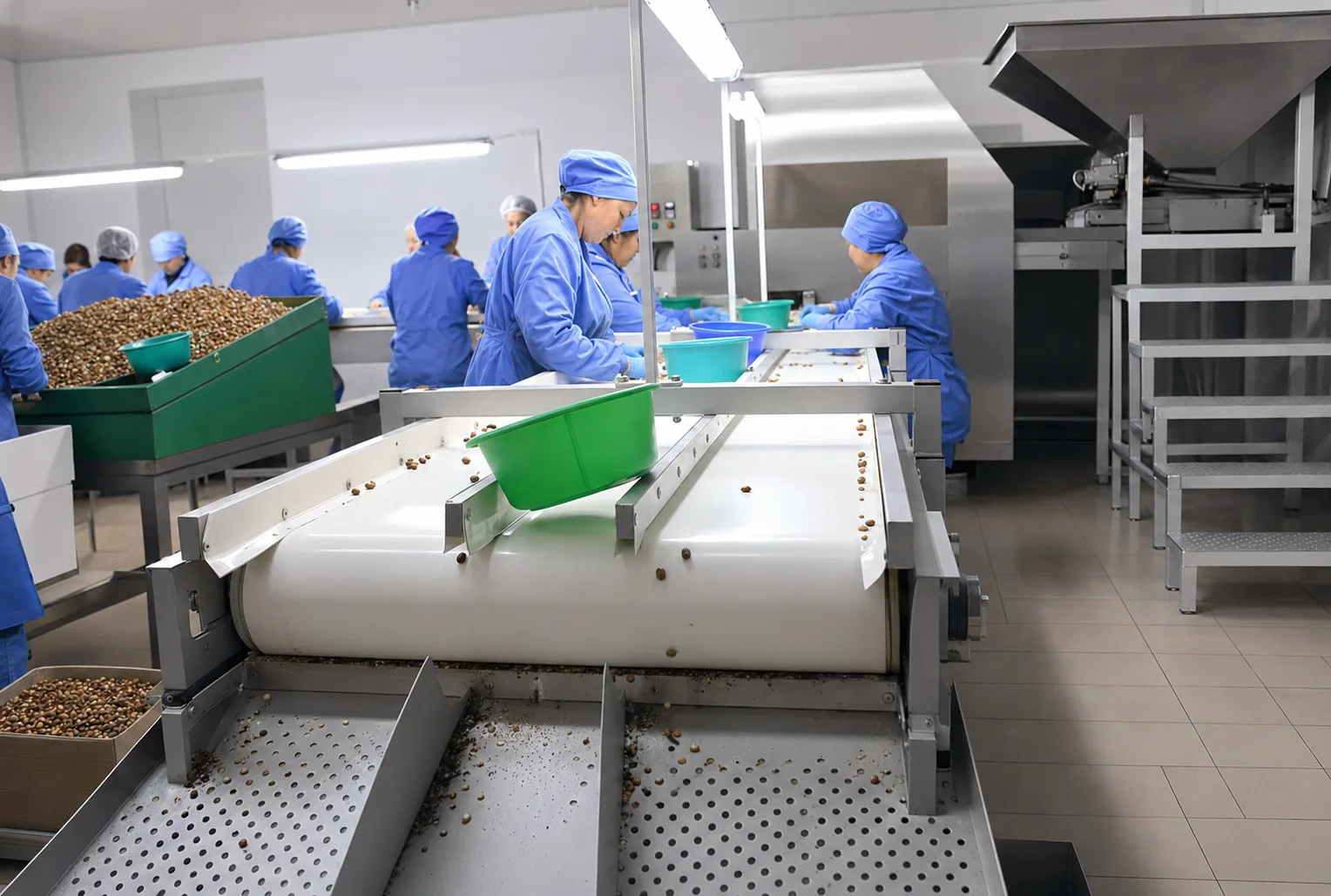
Complete mixing, dosing and packing line
An integrated process line for chemical products, from raw material intake through to the packed product: discharge, internal conveying, mixing, precision gravimetric dosing and feeding of the packing line — with the whole flow automated.
See the project